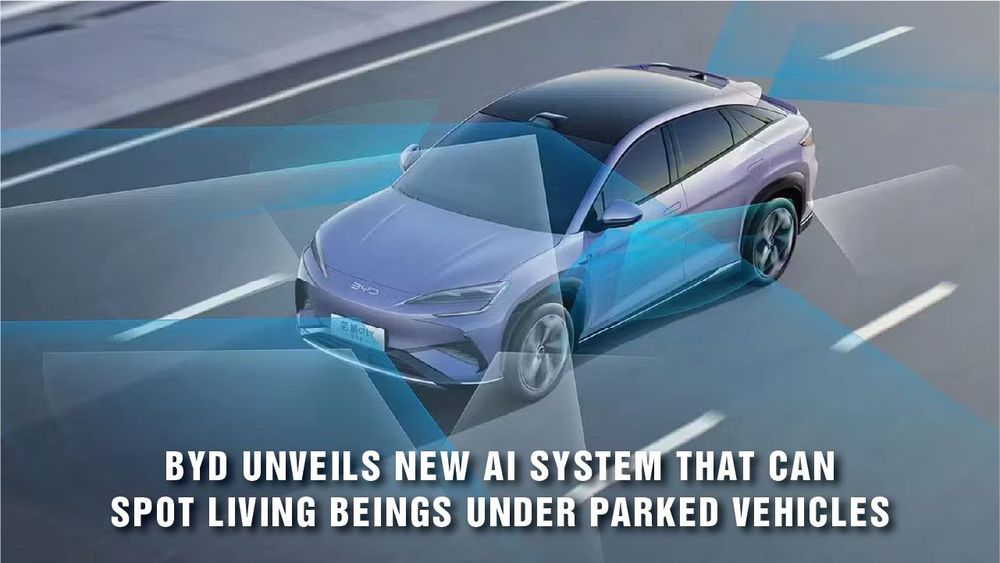
Chinese electric vehicle giant BYD has unveiled a new artificial intelligence-based safety technology capable of detecting people, animals and other living organisms underneath parked vehicles before they begin moving.
The newly patented system is designed to improve vehicle safety by monitoring the area beneath a car and identifying potential hazards that may otherwise go unnoticed by drivers.
By combining computer vision, image comparison and AI-powered object recognition, the technology aims to reduce underbody accidents involving children, pets and other living beings.
How the Technology Works
At the core of the patented system is a baseline imaging process that creates a visual reference of the vehicle’s underside.
When the vehicle is parked, switched off and in a stable condition, the system captures and stores an image of the underbody area. This image serves as a reference snapshot of what the space beneath the vehicle normally looks like.
Before the vehicle starts moving or during a safety inspection, new real-time images are captured and compared against the stored baseline image.
Instead of analyzing the entire underbody every time, the system focuses only on areas where visual differences are detected.
These altered regions are isolated as target images and sent for deeper analysis, significantly reducing computing requirements while enabling faster identification of unusual objects beneath the vehicle.
AI-Powered Safety Technology
Unlike conventional monitoring systems, BYD's patented solution is designed to ignore components that remain unchanged between scans.
Fixed vehicle structures such as:
- Battery pack housings
- Suspension components
- Aerodynamic panels
- Chassis structures
- Other underbody hardware
are treated as part of the reference environment.
This allows the software to focus exclusively on new objects or movements detected after the baseline image has been recorded.
Once a change is identified, the system extracts visual characteristics from the target image and processes them using AI-powered detection algorithms.
The software then determines whether the object is a living organism and can further evaluate its condition or status before issuing a safety warning or triggering additional actions if necessary.
Addressing a Complex Computer Vision Challenge
Detecting living beings underneath vehicles is significantly more challenging than monitoring occupants inside a vehicle cabin.
The space beneath a parked vehicle is highly unpredictable and subject to constantly changing environmental conditions.
Several factors can interfere with accurate detection, including:
- Shifting shadows
- Uneven lighting conditions
- Road debris
- Dust and accumulated dirt
- Different ground textures
- Weather-related visual disturbances
Traditional motion-detection systems often struggle in such environments and may generate false alarms by incorrectly identifying ordinary environmental changes as potential hazards.
BYD’s new approach seeks to overcome these limitations through a more intelligent comparison-based detection process.
Two-Stage Detection Process Improves Accuracy
The patented technology employs a two-stage detection methodology.
In the first stage, the system creates and stores a unique visual reference of the underbody environment beneath each parked vehicle.
When new images are captured, the software quickly identifies any differences compared to the baseline reference.
Only after these changes have been isolated does the second stage begin, where advanced recognition algorithms determine whether the detected object is:
- A person
- An animal
- Another living organism
- A non-living object
This layered approach improves detection accuracy while reducing false positives caused by stationary vehicle components or harmless objects beneath the car.
Part of BYD’s Broader Vehicle Safety Ecosystem
The new underbody detection system aligns with BYD’s broader efforts to expand advanced vehicle safety technologies.
Recently, the company also introduced another patented safety solution that uses radar sensing and signal analysis to detect forgotten occupants inside a vehicle.
Together, the two technologies monitor opposite sides of the vehicle:
- Cabin Monitoring System: Detects occupants left inside the vehicle.
- Underbody Detection System: Identifies living beings beneath the vehicle.
The development suggests that BYD is building a comprehensive safety ecosystem that combines computer vision, radar technology and intelligent monitoring systems to improve overall vehicle awareness and accident prevention.
Future Implications
As vehicles become increasingly intelligent and autonomous, advanced sensing systems such as BYD’s AI-powered underbody monitoring technology could play an important role in enhancing pedestrian, child and animal safety.
By identifying hidden hazards before a vehicle begins moving, the technology has the potential to reduce accidents and provide drivers with greater situational awareness in everyday parking environments.
Conclusion
BYD’s latest patent demonstrates how artificial intelligence and computer vision are being integrated into vehicle safety systems beyond traditional driver assistance features.
By creating a baseline visual map of the vehicle’s underside and analyzing only detected changes, the system can efficiently identify living beings beneath parked cars while minimizing false alarms.
The innovation represents another step toward smarter and safer vehicles capable of monitoring their surroundings more comprehensively before every journey.
Source
Interesting Engineering, CarNewsChina