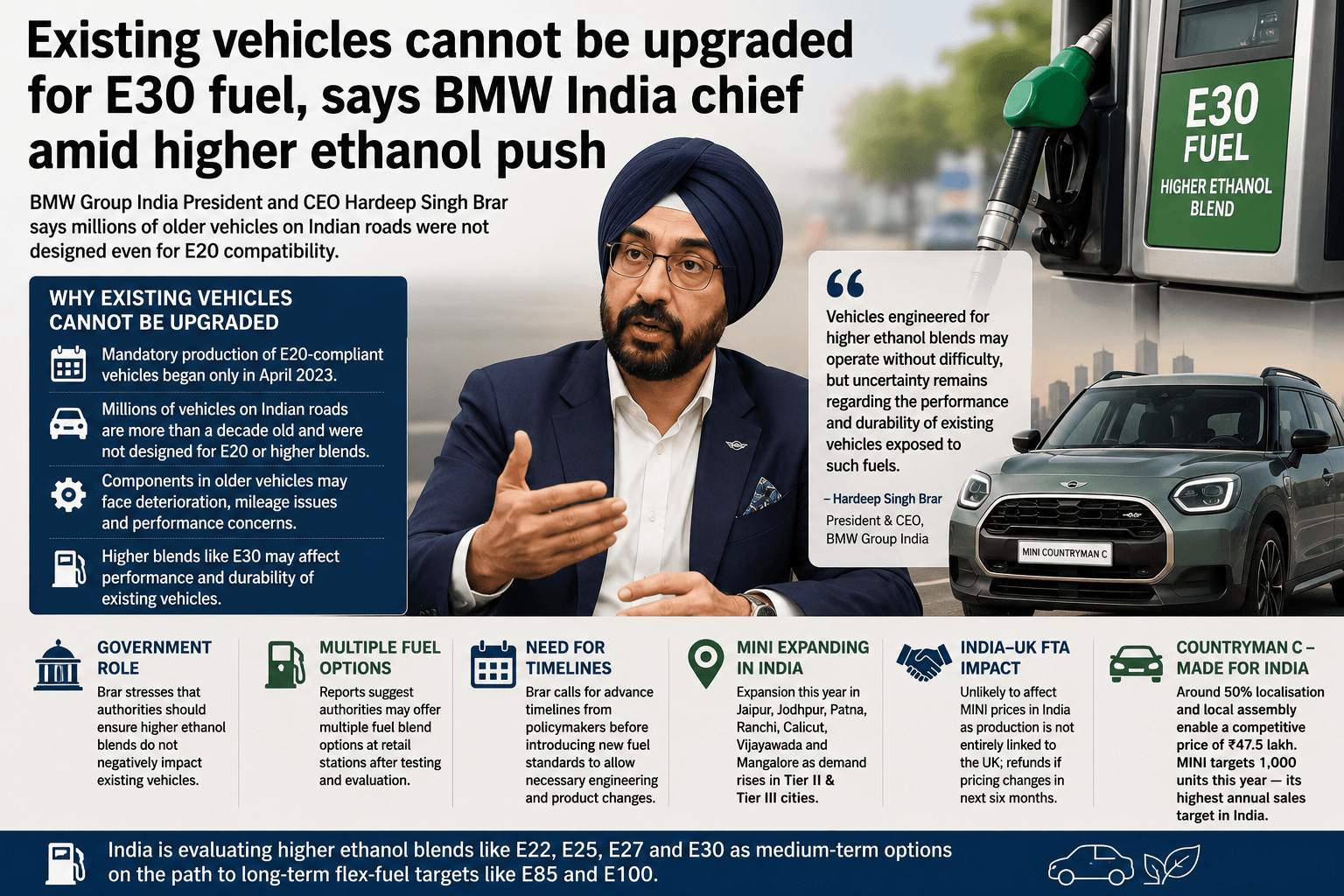
As India explores higher ethanol blending to reduce dependence on imported fuel and also to achieve “Energy Independence” and “Self-Reliant”, BMW Group India President and CEO Hardeep Singh Brar has said existing vehicles cannot simply be upgraded to run on E30 fuel, highlighting concerns over compatibility with older vehicle fleets.
Speaking in an interview with Car and Bike, Brar said the impact of higher ethanol blends on vehicles already operating on Indian roads must be studied carefully before wider implementation, Rush Lane reported.
India has already adopted E20 fuel blending as part of efforts to reduce crude oil imports and strengthen energy security. However, with the government evaluating higher blends such as E22, E25, E27 and E30 as medium-term options ahead of long-term flex-fuel targets like E85 and E100, questions are emerging over vehicle readiness and also the structural problems the vehicles are facing such as the mileage problem and also the components of vehicles are deteriorating.
According to Brar, millions of vehicles currently in use are more than a decade old and were not designed even for E20 compatibility. He pointed out that mandatory production of E20-compliant vehicles began only in April 2023, making the transition to higher blends more complex.
He noted that while vehicles engineered for higher ethanol blends may operate without difficulty, uncertainty remains regarding the performance and durability of existing vehicles exposed to such fuels. Referring to MINI’s experience, Brar indicated that some customer-related fuel compatibility concerns had already surfaced.
He stressed that government agencies should ensure that the rollout of higher ethanol blends does not negatively affect existing vehicles.
Reports have suggested that authorities may consider making multiple fuel blend options available at retail fuel stations after evaluation and testing of higher ethanol blends is completed.
Brar also called for advance timelines from policymakers before introducing new fuel standards, saying such visibility would allow automobile manufacturers to make the required engineering and product adjustments.
Apart from fuel policy, Brar outlined MINI’s expansion plans in India, with the company increasing focus on Tier II and Tier III cities where demand is rising.
The company plans to expand operations this year in cities including Jaipur, Jodhpur, Patna, Ranchi, Calicut, Vijayawada and Mangalore, where demand for MINI vehicles has strengthened.
Commenting on the India–UK free trade agreement, Brar said it is unlikely to affect MINI car prices in India because the company’s production structure is not entirely linked to the UK. However, he added that if pricing changes occur over the next six months, customers could receive refunds.
He also highlighted the recently launched Countryman C, which has around 50 per cent localisation and local assembly, allowing the model to be offered at a competitive price of ₹47.5 lakh. MINI is targeting sales of 1,000 units this year, which would mark its highest annual sales performance in India.