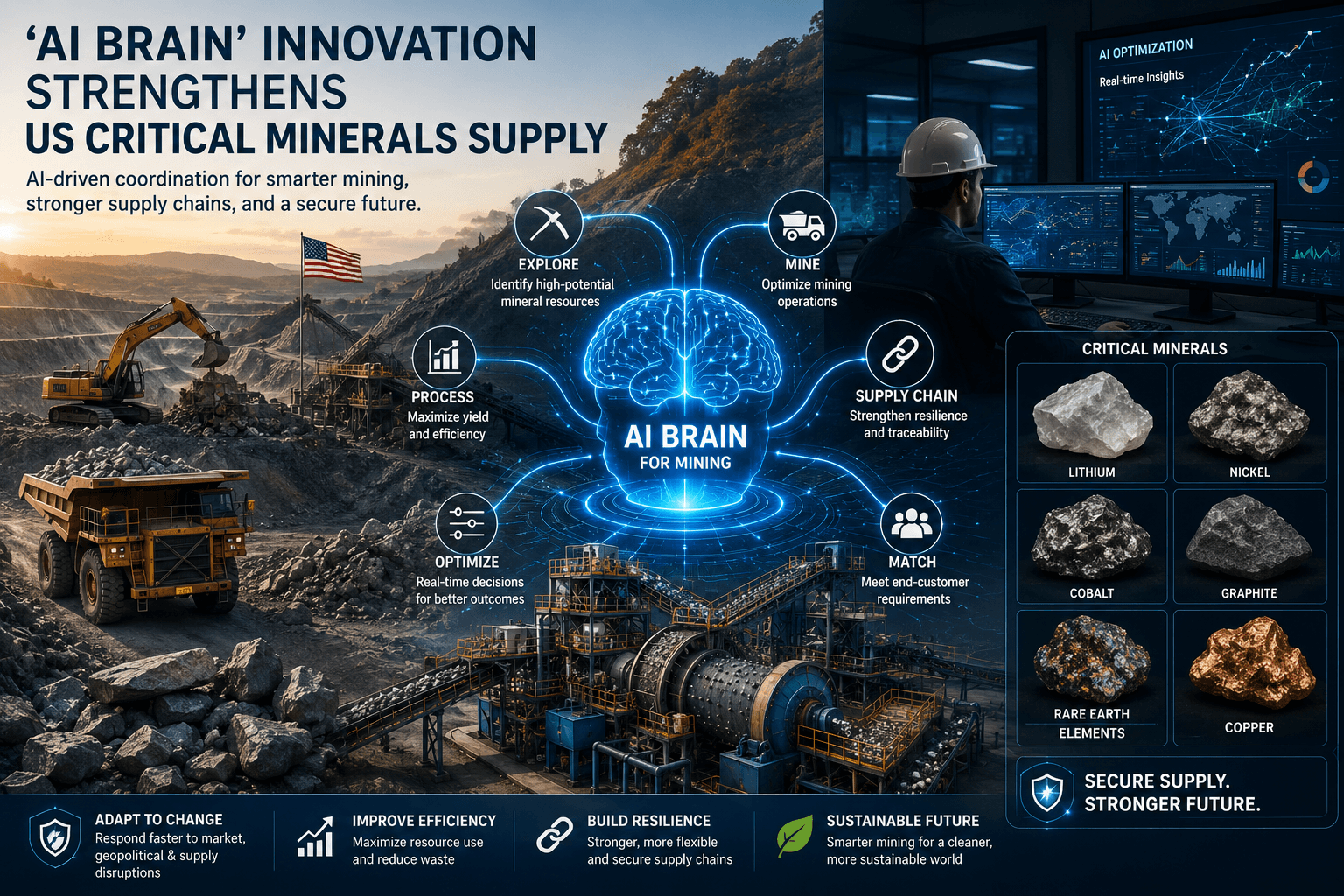
National Laboratory of the Rockies (NLR) researchers are developing an Artificial Intelligence system designed to better coordinate mining operations across the US. In short, they are attempting to build an AI “brain” for the mining industry to better allocate resources and improve yields.
Called Genesis Mission’s Critical Minerals and Materials To Unlock Supply (CM2US), if successful, the ultimate plan is for the “brain” to help decide where best to mine, what to mine, how to process extracted materials, etc. It will also, ideally, help to better manage supply chains and devise ways to make the final material with the properties manufacturers actually need.
“There is a need for more flexibility in the way we approach critical minerals,” NLR computational science researcher Ryan King said.
“My goal is to find ways to contribute to the supply chain durability and technological innovation with these critical assets,” he added.
“In these slow-moving industries, you install processing equipment, and it stays the same for generations,” King said. “But supply chains evolve rapidly, and technological or materials innovation can change the type of feedstocks that are needed,” he added.
ML brain for mining
The need for such a system comes down to the basic fact that most modern technology depends on critical minerals. This includes, but is not limited to, lithium, nickel, cobalt, graphite, rare earth elements, and copper. However, supplies of these minerals are vulnerable to disruption from export restrictions, natural disasters, wars, and shifting geopolitical priorities.
Mining companies traditionally can’t react quickly because mines and processing plants are incredibly expensive and designed to operate the same way for decades. While it cannot eliminate supply disruptions, the ML system could help operators adapt more quickly and reduce their impact.
“At the same time, higher-grade resources may be used up, and we need to then make use of lower-grade resources, or we need to account for geopolitical supply shocks. This means we’re looking for AI solutions in mineral processing that can create output flexibility or absorb input volatility.”
This will include the exploration side of mining, which traditionally relies on human geologists to find potential deposits. The new AI brain will combine large volumes of data points to help in this process rather than relying solely on human interpretation.
The “brain” will also be able to give recommendations during ore processing to determine the best use of raw materials. It will, for example, automatically change how the ore is processed based on its real-time composition to get the best yields possible.
Smarter mining and processing for all
It might also be possible to match processed ore to specific end customers’ requirements dynamically, too. Say one customer requires 68% iron concentrate but another 72%, the AI system could, in theory, alter the processing to match.
“We’re exploring how we can build AI models for all the different steps in the process, and, in a lot of ways, it doesn’t matter what the actual mineral is. You’re faced with a lot of the same AI challenges,” King explained.
“Ultimately, we want to be able to go from exploring rocks in the ground all the way to understanding geopolitical events on their impact on the supply chain,” he said. “Using AI can help us make all of the intermediate connections that are difficult for humans to optimize,” he added.
“AI can plug in anywhere,” King said. “It can play a big role in exploration and extraction. Then, once you get minerals out of the ground, we can use AI to optimize the design and controls of key processing steps like milling, separation, and reduction to achieve desired feedstock characteristics.”
Source:
Interesting Engineering