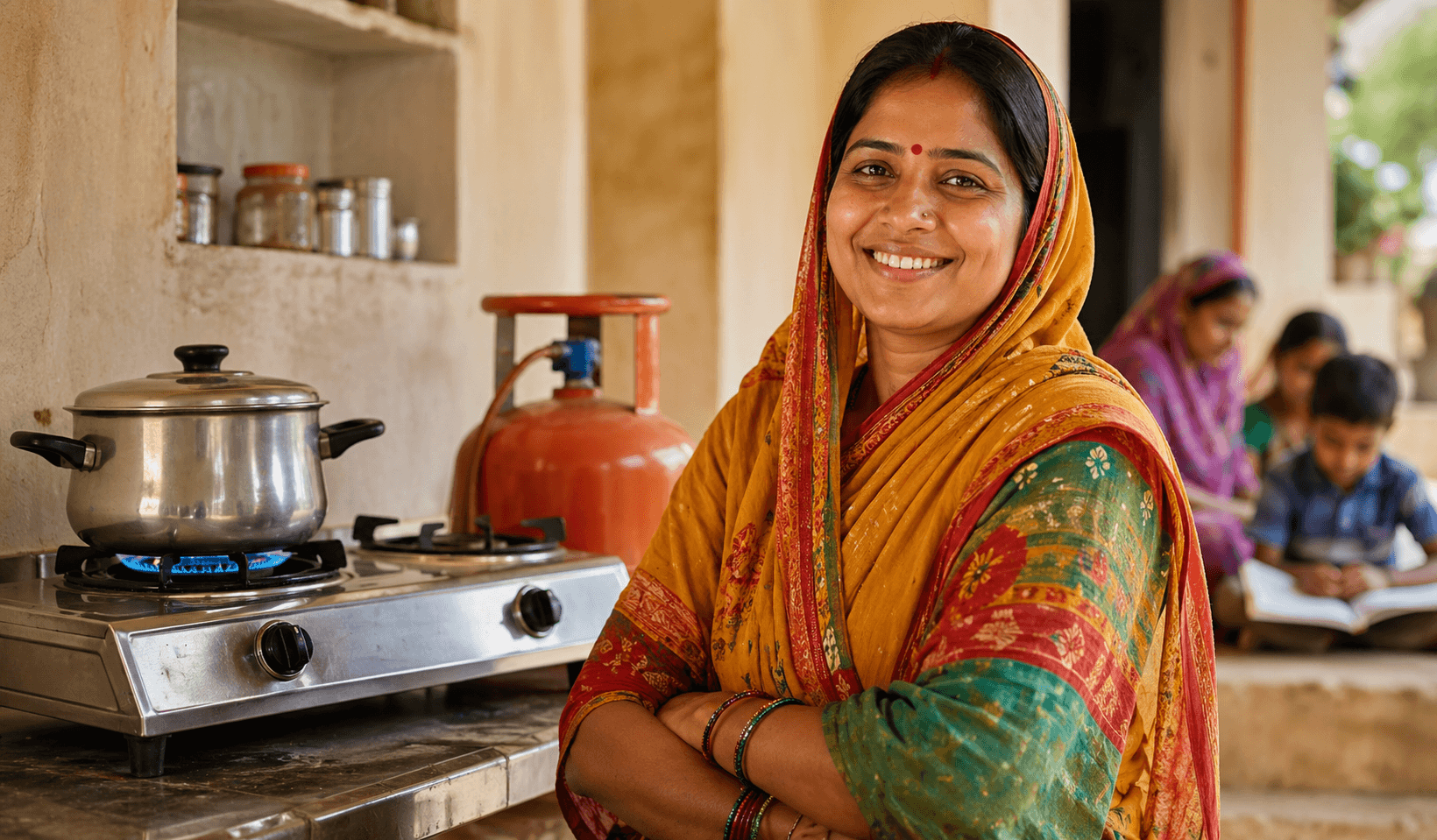
The initiative has significantly improved household health, reduced time spent on fuel collection, and enabled greater participation of women in economic activities.
A decade after its launch, the Pradhan Mantri Ujjwala Yojana (PMUY) has emerged as a powerful example of a broader development shift—where women are not merely beneficiaries of policy, but central to its design and impact.
Introduced in 2016, the scheme was built on the principle that meaningful development begins with improving the everyday lives of women, particularly in rural India. Over time, this women-centric approach has influenced policymaking across sectors. Ujjwala, often referred to as the “Blue Flame Revolution,” stands out as one of the largest clean cooking energy transitions globally.
Ten years on, the scheme has provided clean cooking fuel access to more than 10 crore women across the country.
Before its rollout, LPG access remained limited. In April 2015, LPG coverage stood at 56.2%, and the National Family Health Survey-4 indicated that only 44% of households used clean cooking fuel as their primary source. While electricity had reached many villages, clean cooking solutions were still out of reach for a large population.
The Ujjwala scheme addressed this gap through a simple yet effective design—providing deposit-free LPG connections in the name of women from low-income households.
The initial target of 5 crore connections was achieved in August 2018, followed by the extended target of 8 crore by September 2019. Ujjwala 2.0, launched in August 2021, introduced additional flexibility for migrant families, simplified documentation, and offered a free first refill along with a stove. As of March 2026, the scheme has benefited approximately 10.56 crore women.
Alongside connections, the LPG distribution network has expanded significantly. Total LPG connections in India increased from 14.52 crore in 2014 to 32.83 crore by November 2024. Distribution infrastructure has also strengthened, especially in rural and underserved regions, with public sector oil marketing companies playing a key role.
The JAM trinity—Jan Dhan, Aadhaar, and Mobile—enabled direct subsidy transfers into beneficiaries’ bank accounts, ensuring efficient and transparent delivery of benefits.
The programme’s focus is now evolving beyond access towards ensuring fairness and equity in outcomes. Expansion of LPG coverage is contributing to energy justice, addressing long-standing disparities in access and distribution.
The health benefits of this transition are significant. Household air pollution, long a hidden risk for women and children, has reduced considerably. Cleaner cooking has improved respiratory health and overall well-being, with studies showing lower indoor pollution levels in areas with higher Ujjwala adoption.
Time savings have also played a crucial role. Reduced time spent on collecting fuel and cooking has allowed women to engage more in income-generating activities, strengthening their role within households and communities. This marks a shift from access to empowerment, with broader impacts on education and opportunities, particularly for young girls.
As the scheme enters its second decade, the focus is shifting towards sustained usage. LPG consumption has increased from just over three refills per year in 2019–20 to nearly five refills annually on a pro-rata basis in 2025–26. However, some households continue to rely on a mix of LPG and traditional fuels.
This reflects the complexities of large-scale transitions. Affordability remains a key concern, and policy support continues through targeted subsidies, improved delivery systems, availability of smaller cylinders, and awareness initiatives.
Behavioural change is also emerging as an important factor. Shifts in habits, aspirations, and lifestyle choices are paving the way for the next phase of clean cooking transitions, including the gradual adoption of electric and induction-based cooking solutions.
The government’s commitment to women’s empowerment has been reflected in both policy and legislation. The Nari Shakti Vandan Adhiniyam, enacted in September 2023, marked a significant step forward, while the gender budget has increased from 5.46% in 2014–15 to 8.86% in 2025–26.
Looking ahead, the priority is to ensure that this transformation becomes universal and irreversible. As access to clean cooking enters households, it extends beyond the kitchen—driving improvements in health, education, dignity, and economic opportunity.